The Last Lesson
What Ayla Taught Me About Accompanying the Dying

“We are all just walking each other home.” — Ram Dass
I have sung many death songs.
Each one is different. Every voice carries its own cadence of grief. Every room has its own silence. Some deaths come after long illnesses, others arrive without warning. Yet every time I begin to sing, I find myself standing once again at that strange threshold where love has reached the limits of what it can change, but not the limits of what it can give.
Death was never something I imagined would become part of my life’s work. Yet perhaps I was being prepared for it long before I knew. I grew up between cultures. The world around me often treated death as something to be hidden away, while my Hindu upbringing spoke of it more openly—as a transition, a sacred passage, a reality woven into the fabric of life rather than an interruption of it. Even so, no philosophy, no religion, and no spiritual tradition can make it easy to say goodbye to someone you love.
The animals have become some of my greatest teachers, not because they have answered the mystery of death, but because they have gently invited me to meet it differently.
For many years, I have been drawn to the Zen practice of shikantaza—”just sitting.” It has always struck me as both beautiful and impossibly difficult. To simply be with reality exactly as it is, without reaching for distraction, explanation, or escape, asks something profound of us. I have often thought about that practice while sitting quietly in meditation. I had never thought about it in a veterinary clinic.
I thought Ayla had already taught me everything she came here to teach.
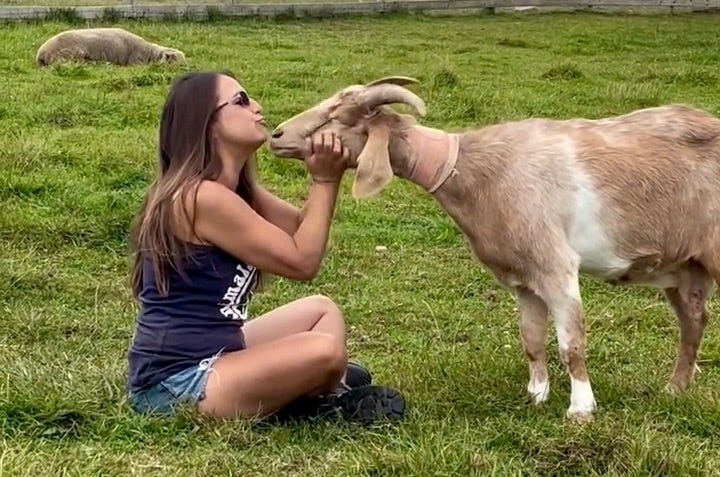
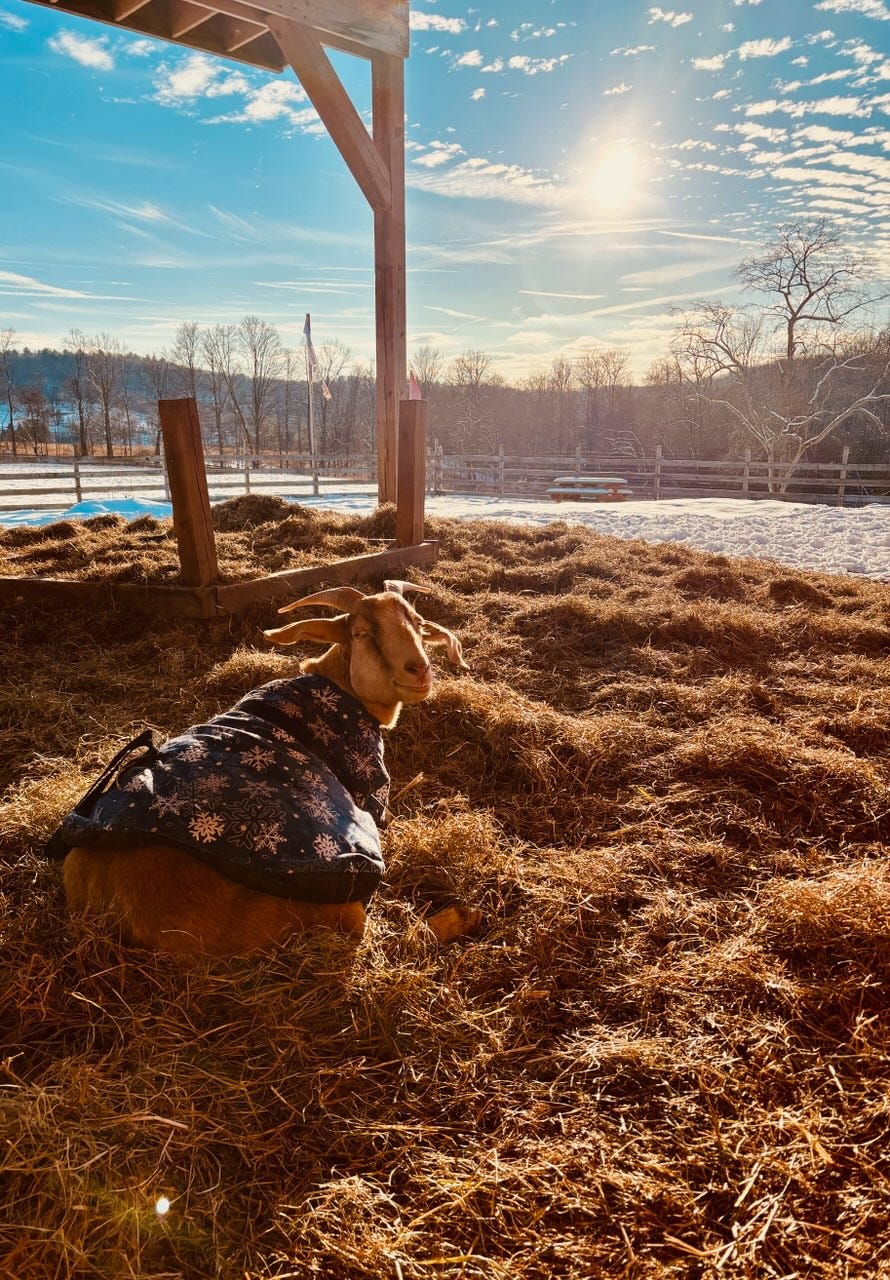
If you have been walking this journey with me for a while, you already know her. You met her as she invited us into resilience and wonder. You celebrated with me as she was reunited with Arlen and Payton after each hospitalization. Through her, we reflected together on tenderness, trust, healing, and the quiet wisdom that animals so often carry without ever trying to teach.
I believed those were the gifts she had come to share. I didn’t yet know there would be one more.
The day before she died, our summer camp was in full swing. Children’s laughter drifted across the sanctuary. Their voices echoed from one pasture to another as they moved through their day with the boundless enthusiasm that belongs to childhood. Ayla had never disliked children, but she usually preferred a little more peace than they naturally bring. Loud groups were not really her thing. More often than not, she would watch them from a comfortable distance and wait for the sanctuary to become quiet again.
That morning, she surprised all of us.
She walked toward them and lingered there, accepting their gentle hands and curious questions with patience. I remember noticing it at the time, though only in passing. It seemed unusual, but not remarkable enough to give much thought to.
Only later did I begin to wonder.
The next morning, my phone began to buzz. “This is the worst seizure I have seen Ayla have.”
I could almost feel the progression in Dr. Leslie’s messages as they came. At first there was concern. Then urgency. Medication after medication failed to stop the seizure. Time passed. Hope remained, but it began to change. It became quieter. More tentative.
“This isn’t looking good.”
By the time I reached the clinic, the familiar smell met me before I opened the door. Antiseptic. Cleaning products. Beneath them, the warm, earthy scent that anyone who has lived with goats knows instantly.
The fluorescent lights were still on when I arrived, casting the room in the harsh brightness so common to clinics and hospitals. At some point, I don’t know who, someone reached up and turned them off. No announcement. No discussion. It simply happened. The room softened, and the only light came through the small window in the door, falling across Ayla as she lay on the floor.
I have thought about that small act many times since.
No one decided that the moment should become sacred. Someone simply knew. Leslie never stopped caring for Ayla. She administered one medication after another with the same steady hands that had cared for her through previous hospitalizations. As she worked, tears rolled down her cheeks and disappeared into Ayla’s fur, joining those of so many of us gathered around her.
The hours passed almost imperceptibly. We whispered to one another, though I no longer remember what we said. Between those whispers there were long stretches of silence. Someone prayed. Someone rested a hand on Ayla's shoulder. Someone else stroked her neck. We cried. We waited.
I don’t remember exactly when I realized the seizure was not going to end. Perhaps none of us could identify the precise moment. It was more like watching daylight slowly fade into evening. There comes a point when you suddenly realize it is dark, though you cannot say exactly when the light disappeared.
Somewhere in those hours, almost without anyone saying so, the question quietly changed. Until then, every decision had been guided by a single hope: How do we bring her back? Gradually another question took its place. It was quieter, but no less important. How do we love her now?
At Indraloka, whenever possible, we bring loved ones to those who are dying. So Shawn went to bring Arlen and Payton. They arrived in the back seat of the truck, just as they always do, trusting us without hesitation. When they entered the clinic, they walked directly to their mother. Each gently sniffed her and then remained nearby, calm and unhurried.
People often ask me what animals understand about death. The older I become, the less certain I am that this is the question worth asking. What I know is what I witnessed. Arlen and Payton came. They recognized their mother. They stayed with her.
Perhaps that is enough.
Around them, we formed our own circle. By then there was no treatment left to prepare and no decision left to make. We simply gathered around Ayla. Hands rested gently on her body, and on one another. Leslie continued caring for her, our tears mingling before disappearing into Ayla's fawn coat. The room seemed to breathe in unison, as though every person and every animal present had become part of the same quiet rhythm.
I found myself looking around the room. No one had planned what was happening. No one had discussed who would stand where, who would pray, who would turn off the lights, or who would bring the babies. It simply unfolded, not according to a protocol, but according to something much older that each of us seemed to recognize without needing to name.
When Leslie administered the sedative, I began to sing.
I have often wondered why human beings have sung at the thresholds of life for thousands of years. We sing when children are born. We sing when two lives are joined together. We sing in worship, in celebration, in protest, and in grief. Long before we understood so much of medicine, we understood that some moments ask something of us that ordinary speech cannot give. Perhaps song is one way we remain present when words have reached their limit.
For days now, I have found myself returning to the Zen practice of shikantaza. I wonder whether I ever understood it as deeply as I thought I did. It is one thing to sit quietly with your breath on a meditation cushion. It is another to remain fully present beside someone you love when every part of you wishes the moment were different.
Perhaps that is why so many of us struggle to accompany those who are dying. Not because we do not love them enough. Because remaining present in the face of suffering may be one of the hardest things a human being is ever asked to do.
I also wonder whether this is something our culture has forgotten.
We have become extraordinarily skilled at treating death as a medical event. We measure it in interventions, outcomes, and survival rates. Yet death has always been more than that. It is also a profoundly relational event. It belongs to families. To communities. To silence. To touch. To prayer. To tears. To songs.
As I have reflected on Ayla’s final hours, I have come to realize that her last lesson was not really about death at all.
It was about love.
Not love that rescues. Not love that fixes. Not even love that understands. Simply love that remains.
As I look back on Ayla’s life, I remain grateful for everything she taught me about resilience, wonder, and tenderness. Yet it is this final gift that has settled most deeply into my heart.
I have been wondering ever since whether learning how to die is only part of the invitation.
Perhaps the deeper invitation is learning how to accompany one another as we do.
And perhaps, on a quiet afternoon in a small veterinary clinic, surrounded by whispers, prayers, tears, song, and the unwavering presence of those who loved her, one gentle goat showed us how.